Deposit Boosts and Market Discrepancy Strategies: Pathways to Prolonged Wagering Consistency
Willa Becker · Jun 27, 2026

Deposit Boosts and Market Discrepancy Strategies: Pathways to Prolonged Wagering Consistency
Recurring deposit boosts function as periodic incentives that platforms extend to existing account holders who add funds on a scheduled basis, and these offers often include percentage matches or fixed credits that extend the available balance for subsequent wagers. Cross-market inconsistency hunting refers to the systematic comparison of odds across different events, bookmakers, and bet types in search of pricing differences that exceed standard margins. When these two elements operate together, participants gain repeated access to additional capital while simultaneously identifying opportunities where implied probabilities diverge from observed outcomes across unrelated markets.
Mechanics of Recurring Deposit Incentives
Platforms structure recurring deposit boosts through tiered reward systems that activate upon each qualifying deposit, and eligibility typically depends on prior activity levels rather than new registrations alone. Data from industry tracking services shows that such programs maintain higher retention rates when paired with clear rollover conditions, which require the boosted amount to circulate through qualifying bets before withdrawal becomes available. Observers note that these incentives appear most frequently in jurisdictions where regulatory frameworks permit ongoing promotional activity without mandating strict time limits on bonus validity.
Payment methods influence the speed and frequency of boost activation, with certain electronic wallets triggering automatic credit allocation within minutes while bank transfers introduce longer processing windows. Research from academic institutions, including studies conducted at the University of Sydney, indicates that participants who align deposit timing with scheduled sporting calendars achieve greater utilization rates of these recurring credits. The structure encourages consistent funding patterns that platforms then monetize through increased overall handle across multiple product verticals.
Cross-Market Inconsistency Detection Methods
Participants scan live and pre-match markets simultaneously, comparing decimal, fractional, and American odds formats to locate instances where the combined probabilities leave room for positive expected value when wagers are placed in opposing directions. Software tools aggregate feeds from multiple operators, highlighting discrepancies in real time while accounting for commission rates and currency conversion differences. Those who have studied these patterns report that inconsistencies appear more regularly in lower-profile leagues and emerging bet types where liquidity remains thin and pricing adjustments lag behind information flow.
June 2026 data compiled by the European Gaming and Betting Association reveals that operators in several member states adjusted their risk management protocols after observing increased activity around cross-market positioning, particularly during major international tournaments. The report notes that detection systems now incorporate machine learning filters to distinguish between genuine pricing variances and temporary feed delays, thereby reducing the window during which such opportunities remain exploitable.
Integration of the Two Approaches
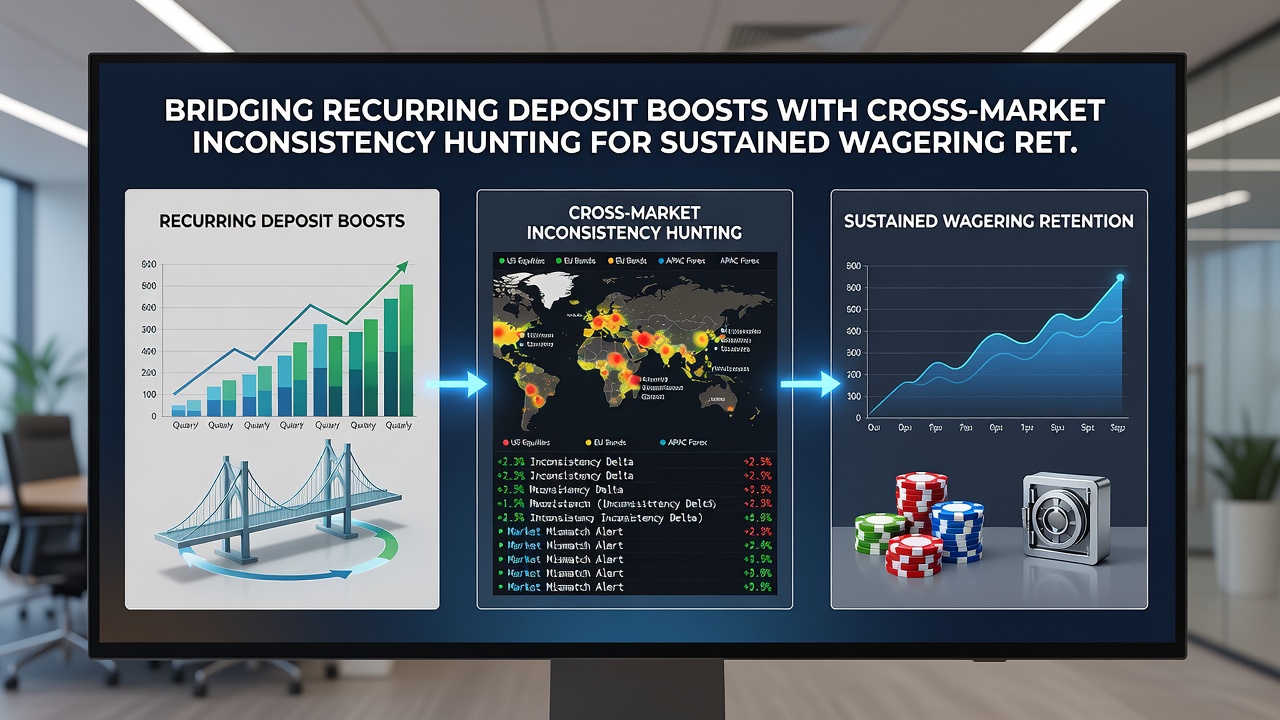
Combining recurring deposit boosts with inconsistency hunting creates a cycle in which fresh capital enters accounts at regular intervals while identified discrepancies provide outlets for that capital. The process requires careful tracking of bonus terms against the specific markets being targeted, since some operators exclude certain bet types from contributing toward rollover requirements. Participants coordinate deposit schedules with tournament calendars so that boosted balances coincide with periods when cross-market variances historically widen, such as during overlapping football and tennis schedules.
Case examples from professional syndicates illustrate how teams divide responsibilities, with one group monitoring deposit promotions across platforms while another focuses on real-time odds aggregation. This division allows sustained operation even when individual operators impose temporary limits following large volume activity. Figures from Canadian regulatory filings show that accounts utilizing both recurring incentives and multi-market positioning maintained longer active lifespans compared with those relying solely on one method, although aggregate profit margins remained modest after accounting for transaction costs and time investment.
Operational Considerations in Mid-2026
Regulatory updates implemented in several Australian states during early 2026 introduced additional reporting requirements for operators offering recurring deposit programs, and these changes affected how quickly boosts could be credited following each deposit. Meanwhile, technological improvements in odds comparison engines have shortened the average lifespan of detectable inconsistencies, pushing practitioners toward less liquid markets in niche sports. Those monitoring industry trends note that successful integration now depends more heavily on precise timing and multi-account coordination rather than on any single large discrepancy.
Conclusion
The practice of linking recurring deposit boosts with cross-market inconsistency hunting continues to evolve alongside platform policies and regulatory environments. Available data indicates measurable differences in account longevity when the two methods operate in tandem, yet outcomes remain dependent on execution quality, jurisdictional rules, and the speed at which operators adjust pricing. Observers continue to track these developments through industry reports and academic analyses as the landscape shifts through the remainder of 2026 and beyond.